

With the rapid development of industrial automation and smart manufacturing, chain drive technology, as a core link in mechanical power transmission, plays an irreplaceable role in mining, metallurgy, food processing, and other fields. Among them, the plate link conveyor chain has become an excellent solution for continuous material conveyance in production lines due to its high load capacity, stability, and modular design. However, faced with a wide variety of products on the market, how does one select a suitable plate link conveyor chain based on actual needs? As a chain drive manufacturer, this article will provide a systematic selection guide from four key dimensions: material characteristics, environmental conditions, operating parameters, and drive methods.
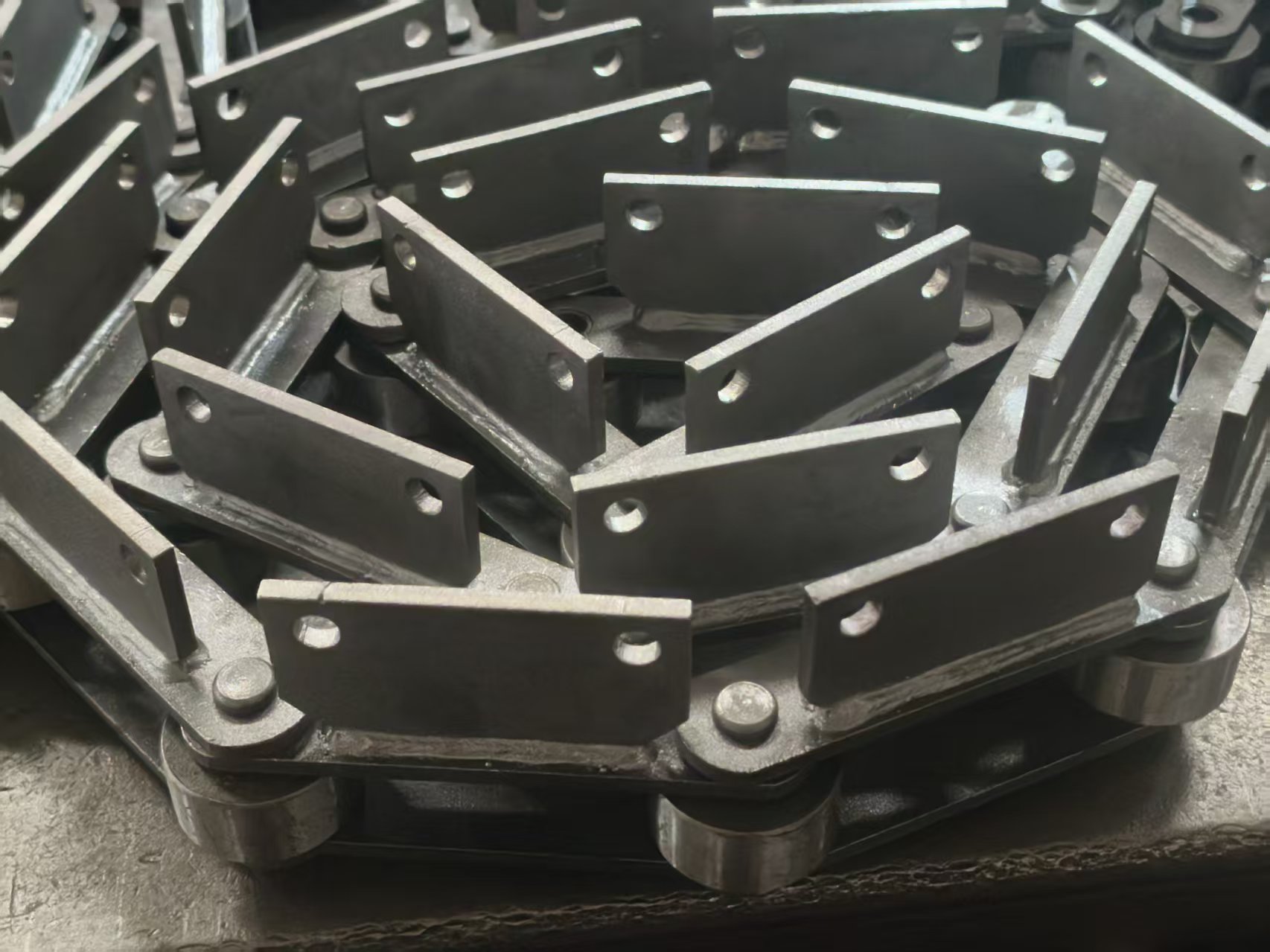
I. Material Type and Size: Determining the Chain's Load-bearing Design
The core function of a plate link conveyor chain is to transport materials stably and rapidly; therefore, the characteristics of the material itself are the primary basis for selection.
-
Material Weight and Volume
-
For large, heavy materials (e.g., ores, metal castings), it is necessary to choose plate link chains with wide and thickened chain plates, for example, using alloy steel material and adding transverse support structures to distribute the load pressure.
-
For conveying lightweight materials (e.g., plastic pellets, cardboard boxes), light-duty chains (e.g., carbon steel galvanized plate link chains) can be selected, reducing both cost and energy consumption.
-
-
Material Form and Abrasiveness
-
Powder or liquid materials require a sealed chain plate design to prevent leakage.
-
Sharp or highly abrasive materials (e.g., glass fragments) require wear-resistant coatings on the chain plate surface to extend chain life.
-
-
Chain Manufacturer Recommendation: Calculate the load per unit length of the chain based on the material's maximum single weight and bulk density, and include a 20% safety margin.
II. Conveying Environment: Adaptability of Materials and Processes
The operating environment of the plate link conveyor chain directly affects its material selection and surface treatment processes.
-
High or Low Temperature Environments
-
High-temperature scenarios (e.g., foundry workshops): Require heat-resistant steel (e.g., 310S stainless steel) chains, with working temperatures up to 1000°C.
-
Low-temperature environments (e.g., cold storage): Select austenitic stainless steel with good low-temperature toughness to avoid brittle fracture.
-
-
Corrosive Media
-
In environments such as chemical plants and wastewater treatment, priority should be given to all-stainless steel plate link conveyor chains, or carbon steel chains should be galvanized or powder-coated to enhance rust resistance.
-
-
Humidity and Cleanliness Requirements
-
The food and pharmaceutical industries require compliance with hygiene standards. It is recommended to use polished stainless steel chain plates that are easy to clean, or engineering plastic materials that comply with FDA certification.
-
III. Conveying Speed and Capacity: Matching the Production Rhythm
The efficiency of the chain drive system is directly linked to production line capacity and needs to be accurately matched through the following parameters:
-
Conveying Speed
-
High-speed conveyance (>30 m/min): Requires a combination of precision roller chains and high-strength chain plates to reduce vibration and noise.
-
Low-speed, heavy-duty scenarios: Focus on the rigid design of the chain, such as increasing chain plate thickness and pin diameter.
-
-
Capacity Calculation
-
Based on the formula Q = 3600 × A × v × ρ (where Q is capacity, A is the cross-sectional area of the material on the chain, v is speed, and ρ is material density), determine the required chain plate width and pitch.
-
For example, when conveying coal (ρ ≈ 0.8 t/m³), if the required capacity Q is 50 t/h, a plate link conveyor chain with a chain plate width ≥ 600mm needs to be selected.
-
IV. Drive Method: Synergistic Optimization of the Power System
The drive configuration for a plate link conveyor chain requires comprehensive consideration of energy consumption, control precision, and maintenance costs.
-
Motor Drive
-
Variable Frequency Drive (VFD) Motors: Suitable for production lines requiring frequent speed adjustment (e.g., sorting systems), offering energy savings and flexible control.
-
Standard Asynchronous Motors: Lower cost, suitable for continuous conveyance at fixed speeds.
-
-
Sprocket Drive Layout
-
Single-side Drive: Simple structure, but prone to chain tracking issues over long distances.
-
Dual-side Synchronous Drive: Ensures stability for ultra-long conveyor lines by distributing power through dual motors or a gearbox.
-
-
Auxiliary Devices
-
In inclined or vertical conveying scenarios, hydraulic tensioning devices or backstops can be added to prevent chain reversal.
-
Summary
Selecting the right plate link conveyor chain is a systematic project that requires comprehensive evaluation from four major dimensions: material characteristics, environmental tolerance, conveying efficiency, and drive compatibility. As a manufacturer deeply rooted in the chain drive field for many years, Donghu recommends that users fully investigate production needs before selection and collaborate with our team on design to ensure stable operation and long service life of the conveyor chain. In the future, with the popularization of intelligent monitoring technology, plate link conveyor chains will further enhance their capabilities for fault prediction and adaptive adjustment, injecting stronger power into industrial automation.